

Acerca del autor
No sabes quién soy... pero estás en la página web que he creado. He reflexionado una y otra vez sobre cómo ayudarte a comprender la importancia de mi propia experiencia personal para ti... el lector. No quieres saber nada de mí, ¿verdad? Quieres un currículum impecable que demuestre por qué soy perfecto para este puesto. Y con eso puedo decirte que no te ofrezco nada de lo que esperas. Este camino es espiritual... y así fue como llegué a conocer al Padre Baraga...
-----------
Al ponerme frente a la Cruz del Padre Baraga, sentí que no estaba solo en el mundo. Él me comprendía. Comprendía los dos caminos que había recorrido en esta vida. Comprendía mi corazón.
Lo que uno no sabe es que, antes de ponerme frente a esa cruz, caminé 418 kilómetros con solo dos bastones en mi mochila y un abanico de madera. Llevaba fresas secas, una concha de abulón, salvia y tabaco. Desde la frontera con Wisconsin hasta las cataratas Cascade, al sur de Grand Marais, mi madre y yo caminamos. Hicimos excursiones de fin de semana y travesías largas, pero durante todo el recorrido llevamos con nosotras la canción que nos enseñó una abuela ojibwa. En cada río o arroyo importante que encontrábamos, cantábamos esta canción. Pasábamos tiempo con el agua. Realizábamos la ceremonia.
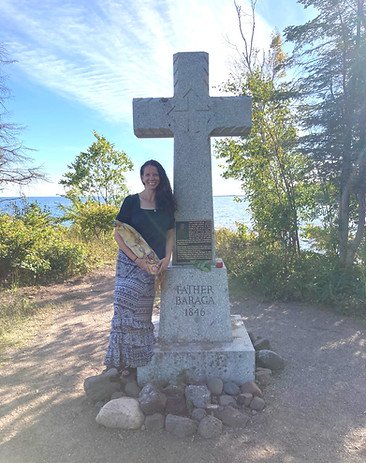
Yo en la Cruz del Padre Baraga sosteniendo mi bolsa de pipa en 2022, dos años después de mi visita inicial a la cruz en 2020.
The Pipe and Chapel Prayer: May 24, 2020
This pipe and pipe bag, that I'm holding in the picture above, were the beginning of an important prayer that were said on the date above in a small chapel at a Catholic School that I was working in. With gratitude, the Chaplain that worked there was willing to leave it open for me after work so that I could have time to pray alone. On one of these days, before knowing anything about Baraga I nervously brought my pipe into this chapel. I often went to visit the chapel after my work was completed for the day to just pray. On this day the school was quiet. No one was around. It was just me, the crucifix and my pipe.
I remember kneeling in the middle of the floor. As I kneeled I laid out my pipe in this pipe bag in front of me right in front of the altar. I took a breath. I felt the discomfort of this moment in thinking about what people would think about me doing this. 'How could you bring a Native pipe here? This is the place of Christ.' 'They're Pagans! What are you thinking.'
I took another breath as I thought about all the paths that I had been on. This pipe was in front of me for a reason. I had carved it myself. I had smoked it myself. I knew the ceremony. I understood the importance to the Native people...because quite simply...God had brought me down this path. Now here I knelt in a completely different place. In front of me was an altar. Next to me were the pews. I had thought of what the Natives taught me about the boarding schools...but I also knew Christ. This moment, this place, represented Him. In was He who brought me to understand the Native world...and now I had to reconcile the Pipe and Christ.
It was in this chapel that I prayed. I said, "Father...help me to understand why you brought me down these two different paths. Help me to make sense of this journey. It was then that I prayed to as many Saints names as I knew. I prayed for a blessing upon the pipe. I prayed for their guidance. "St. Francis de Assisi, St. Thomas, Mother Mary, St. Peter..."
Pope Francis: April 2022
My eyes were fixed on the computer in front of me. I saw the inside of the Vatican and Pope Francis sitting. I saw a Native elder in a headdress in the front rows. The introduction spoke of walking together towards reconciliation. And then I saw another Native elder walking towards Pope Francis holding his Native pipe. He spoke in English...and then in his native language. And then he prayed in the four directions with his pipe...
Kamloops: May 2021
In May of 2021, this story about Kamloops created the urgency of Pope Francis speaking to the world from the Vatican. Simultaneously the prayer that I said in the chapel was about to be answered. During that time an image suddenly flashed in front of me randomly as I was walking into my home. I saw a tombstone and inscribed on the tombstone were these exact words, "In remembrance of all the children who lost their lives in the boarding schools." It was a black tombstone set at an angle with those words etched out in gray.
I set the vision aside until that weekend. That very weekend I went to a sweat. I heard everyone praying inside the sweat for the children. I was confused as to what they were referring to, but it seemed as though everyone knew. When the sweat was completed I laid in the grass and then asked the person next to me, "What was everyone praying about in there? What were they talking about when they mentioned the children?" He said back, "Didn't you hear? 215 children were found buried in the back of a boarding school."
Madeline Island: Early September 2020
In 2019, my mother and I had decided to hike 311 miles on the Superior Hiking Trail which journeyed on the western side of Lake Superior from Wisconsin to Canada. We were taught, just prior to leaving, the Ojibwe water ceremony and decided to perform this water ceremony for each of the major waterways that we crossed along the way. The first year we just hiked on the weekends and on the second year we decided to do a thru-hike. Unbeknownst to us, the first year ended just prior to arriving at a landmark called Father Baraga's Cross.
In preparation for the second year in 2020, we ended up training on this little 14 mile island called Madeline Island. It was a spontaneous invitation from friends who saw that we were heading to the western side of Lake Superior. They had just happened to have a cabin rented the exact same weekend that we were looking to travel north...so we naturally said 'yes'. When we arrived at Madeline Island we were excited to see all the sites on the island. One particular location everyone discussed. "You have to see the museum!" "Yes, the museum!"
We saw the cemetery on Madeline Island and there was a little plaque that mentioned the first Catholic Church built in that location. I noted the Catholic Church given that I had just came from a Catholic School, but nothing further stood out. At last we were going to visit the museum prior to our departure. The doors were closed and a sign on the door read, "Closed due to high winds." Soon we found our vehicles parked on the boat that would bring us back to shore.
Father Baraga's Cross: Late September 2020
My mother and I traveled over 100 miles on the SHT the second year. It was a thru-hike, so we needed to continually resupply our backpacks. We would rest every three days at a motel south of where we were trekking, but each time we headed north and then south again we would see this sign that said, "Father Baraga's Cross". Each time we passed it, we said to each other, "We need to stop there", but then would continue on our trek.
It wasn't until the 100th mile that my mom suddenly found herself having excruciating pain in not one, but both ankles. Unsure how to handle it we decided to rent a motel for a week in hopes that the pain would alleviate and we could continue our trek. Soon, after getting settled into the motel, we both said that we wanted to finally go see this place called Father Baraga's Cross. So we journeyed north.
When I stepped in front of Father Baraga's Cross, I was immediately intrigued. "Father Baraga came from Madeline Island." Madeline Island? I thought of how far that was from Schroeder, MN having just been there. "He was there to help the Ojibwe". The Ojibwe? I thought of the water ceremony that my mom and I brought with us. The connections were to many. I wanted to learn more.
As we were leaving there was a man there that we had seen the day before as we descended Cascade Falls to the motel. Both my mother and I felt that there was something different about him that day, but we couldn't figure it out and just left. But that day my mom saw him and said, "Oh hi!" Immediately he covered his face (due to covid) in a somewhat startled response. My mom said something to him as I headed back to the car and she followed behind.
"Do you think he's a priest, mom?" We spoke to each other when we got in the car. He was wearing plain clothes, but he had a different feeling around him. "He could be." The feeling grew for me to find out who he was, but I chose to leave. As I left though the feeling grew stronger and stronger yet. Finally, at the end of the driveway, I had this feeling that if I chose to leave, I would forever have wondered who he was.
....He pulled up behind me, I stepped out of my car and asked him, "Are you a Father?" He said, "Do you mean a priest?" In my mind I immediately realized how that question could have been seen. I said yes and he said that he was. Unsure as to why I needed to talk to him I asked if he gave Mass and soon he wrote down his name and information for me. I left having still no idea why I was to talk with him.
Father Baraga's Appearance: Late September 2020
My mom and I headed back to the motel room to rest up some more. Soon we found ourselves immersed in reading about Father Baraga. We looked up pictures of him. To my regret I immediately said that I thought he looked 'grumpy' not realizing that he had a stroke just prior to the one picture being taken. I saw other pictures of him and showed them to my mom. Then I read the basics about him. After reading what was online my only take away was that he was a missionary that was only there to convert the Native populations. After this realization, I had no interest in learning about him anymore. I set my computer aside (which was used to help plan for the trail) and decided to leave Baraga alone entirely.
Two days later, my mom and I were in the middle of a conversation. We were discussing the two priests that I had known. We were talking about the Chaplain from the Catholic School and the Priest that we had met at Father Baraga's Cross that day. We were discussing how we knew that the priest at the cross was a priest given that he confirmed he was indeed a priest. I was in the middle of comparing him to the feeling of peace that I had around the Chaplain of the Catholic School.
We were talking about how to explain this feeling of peace to others. Then...in the middle of the conversation...I felt like there was a presence to the left of me. It was not a presence that left me wondering if what i was feeling was real. Instead it was a stark presence and I knew that someone was in the room that was from the other side. It was so strong that I had completely stopped the conversation with my mother, who was sitting across from me, to exclaim "Whoa....who just came into our motel room?" I was completely caught off guard. My mother was calmly sitting across from me staring to my left where I felt the presence. She said calmly, "It's Father Baraga." I then said loudly out of shock, "What is Father Baraga doing in our motel room??" She then calmly responded back again not paying attention to my words, "He's a lot shorter than I thought he would be."
We then started to go over all the reasons that he may have appeared. She said during that whole time we were having that conversation that he just calmly looked back and forth between us. I wrote everything we discussed down on a notepad and then took that notepad home.
Meeting with the Ojibwe Madeline Island Ancestors: October 2020

Yo, Bud y Rona, de la asociación Guardianes de la Sagrada Tradición de los Fabricantes de Pipas en Pipestone, Minnesota, donde trabajé durante varios meses aprendiendo sobre las pipas nativas y las historias nativas.
Luego me ofrecieron un trabajo en Pipestone, Minnesota. Allí estudiaba a Baraga por las mañanas, aprendía sobre las pipas nativas y entonces... resulta que... el dueño de la tienda era de la Reserva Bad River. Un día estaba hablando de una persona que estaba investigando... William Warren. El dueño estaba sentado frente a mí en la mesa. "Sí... lo conozco". Le dije: "Espera... ¿cómo lo conoces?". Me respondió con naturalidad: "Es pariente mío". Le pregunté: "Espera... ¿cuántas de las personas que estoy investigando son parientes tuyos?". Repasó la lista. ¡Resulta que estaba sentado frente a una de las personas que era descendiente de los nativos con los que el Padre Baraga trabajó directamente! ¡No lo podía creer!
Fue en ese lugar donde llamé al padre que también conocí en la parroquia de la Cruz del Padre Baraga. Quería saber por qué quería detenerlo y averiguar quién era. Le pregunté si daba clases. No. Le pregunté si podía ayudarme a hacerme miembro de la iglesia. No podía. Tenía que ir a un programa llamado RICA (Rito de Iniciación Cristiana para Adultos). Le pregunté si transmitía la misa en línea. No. Le hice todas las preguntas que pude. Luego le conté mi historia y le dije que había ido a la parroquia de la Cruz del Padre Baraga poco después de trabajar en una escuela católica. "¿Ah, sí? ¿En qué escuela católica trabajabas?" Le dije el nombre de la escuela. Entonces me preguntó: "¿Conocías al capellán de entonces?" Le dije que sí y le dije su nombre. Me dijo: "¡Fui al seminario con él!" Le dije: "¡Me estás tomando el pelo!" Se rió entre dientes. No recuerdo qué dije después.
There are no accidents
Pero ese momento fue el que más me impactó. En el año 2022, dos años después de comenzar mi investigación sobre Baraga, el Papa Francisco invitó a las poblaciones indígenas al Vaticano. Me senté frente a mi computadora y lo observé todo. Pero lo que me causó un momento de absoluta admiración fue cuando se permitió la entrada de la pipa indígena al Vaticano. Entonces los vi rezar con ella y ofrecerla en las cuatro direcciones. En ese momento me sentí profundamente humillado. Fui a la capilla con mi pipa. Fui allí y ni siquiera podía sacarla de la bolsa. Tenía tanto miedo que ni siquiera podía sacarla. Y ahora veo al Papa Francisco reconciliándose con los daños que ocurrieron en los internados y la pipa estaba fuera... estaban rezando en las cuatro direcciones. Lloré. Literalmente me senté y lloré.
De repente me di cuenta de que el camino que recorría tenía un propósito. Este viaje de la vida no fue casual. Fue intencional. Fue para este momento. No soy católica. No soy indígena. No soy oradora. No soy escritora. La historia era mi asignatura menos favorita, pero ahora no me canso de ella. Soy archivista... contable... y escribo no solo el registro de la vida del Padre Baraga, sino también el de la mía, ofreciendo el camino único que me trajo para compartir estas historias con ustedes. Soy una persona dispuesta a decir "sí" a Dios cuando me llama a un camino donde se me necesita, así que esto para mí es un llamado... un llamado de lo más profundo.
Y lo que puedo decir es esto... De todas las personas que he conocido, y con el profundo conocimiento que he adquirido sobre Baraga y estas historias... Baraga es un santo sin reservas. Es más que merecedor de ese título. Y esto viene de la mujer que no quería tener nada que ver con el catolicismo debido a las historias del internado. Para entender por qué es un santo, hay que conocer las historias de los nativos. Hay que comprender lo que los nativos soportaron para comprender verdaderamente la profunda compasión y determinación de este hombre. Pero cuando uno comprende estas cosas, no puede negar que Baraga es más que merecedor de un obituario que ocupara dos páginas completas de un periódico. Esa fue su influencia. Ese era el tipo de persona que realmente era.