


Nosse (Padre) Baraga
(1797-1868)
El padre Baraga fue un misionero católico que vivió y trabajó con los nativos ojibwe desde 1831 hasta 1868 en las regiones del lago Superior y el lago Michigan. Fue consagrado obispo en 1863. Se le conoció por su celo y compasión hacia los ojibwe durante una época en la que sufrían presión para ser desplazados, cuando los comerciantes de pieles actuaban en su contra y cuando los colonos invadían sus territorios.
El padre Baraga dejó un legado de cuidado y preocupación para todos. Confirmó a más de mil personas en la fe católica y se le conoció como el sacerdote de las raquetas de nieve por su capacidad de recorrer cientos de kilómetros con raquetas de nieve para estar presente cuando alguien lo necesitaba. Conozca más sobre este increíble misionero y el pueblo ojibwe al que sirvió a continuación.
El padre Baraga fue un misionero católico que vivió y trabajó con los nativos ojibwe desde 1831 hasta 1868 en las regiones del lago Superior y el lago Michigan. Fue consagrado obispo en 1863. Se le conoció por su celo y compasión hacia los ojibwe durante una época en la que sufrían presión para ser desplazados, cuando los comerciantes de pieles actuaban en su contra y cuando los colonos invadían sus territorios.
El padre Baraga dejó un legado de cuidado y preocupación para todos. Confirmó a más de mil personas en la fe católica y se le conoció como el sacerdote de las raquetas de nieve por su capacidad de recorrer cientos de kilómetros con raquetas de nieve para estar presente cuando alguien lo necesitaba. Conozca más sobre este increíble misionero y el pueblo ojibwe al que sirvió a continuación.
Gritar
Arquidiócesis de Minneapolis/St. Paul, Minnesota
¡Un saludo especial a la Arquidiócesis de Minneapolis/St. Paul! En un evento reciente que celebraron en el Mall of America, llamado Vatican Unveiled , ofrecieron varios obsequios a la venta al finalizar el evento. Uno de los libros disponibles era "Catholics in the Northland: A History of the Archdiocese of Saint Paul and Minneapolis". En las primeras páginas se incluían las historias reales de las poblaciones nativas. Se mostraban fotografías de los nativos con sus pipas, la historia de los comerciantes de pieles y algunos de los cambios impuestos a las poblaciones nativas tras la llegada de los europeos. No dude en solicitar su libro en el siguiente enlace para conocer la impresionante labor que la Arquidiócesis ha realizado en la región de Minneapolis/St. Paul.

Intercesiones
La intercesión de Baraga
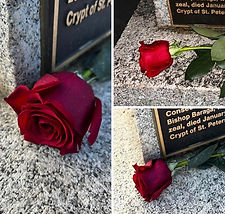
A la izquierda verás dos fotos de la misma rosa. Si miras la de arriba, verás que es de noche. Si miras la de abajo, verás que es de día. La rosa de la izquierda es un primer plano de la rosa misma... una semana después de haber sido dejada a la intemperie a orillas del lago Superior.
Pedí una intercesión... y obtuve lo que pedí... pero no de la manera que esperaba...
Página popular
Planifica tu peregrinación

La fotografía muestra un arcoíris detrás de la Cruz del Padre Baraga, ubicada en Schroeder, Minnesota, que simboliza la esperanza en el futuro. Esta fotografía fue tomada por el autor.
¡Desde enero de 2025, la página para planificar tu peregrinación está completamente actualizada! Visítala para ver las últimas novedades, que incluyen una descripción emergente al hacer clic en el sitio, nuevos iconos que indican el tipo de sitio e indicaciones para llegar en coche, disponibles mediante un enlace en la esquina superior derecha de la descripción emergente. Todo esto se ha creado para que la página sea más fácil de usar tanto en dispositivos móviles como en ordenadores. ¡Explora!
Gurú de la investigación
Cronología del padre Baraga

Esta es una página que uso frecuentemente como referencia. Muestra la comparación entre lo que sucedía con el padre Baraga y lo que ocurría con los ojibwe a la derecha. Contextualiza sus misiones al mostrar directamente las experiencias de los ojibwe durante su labor y los logros alcanzados.
Página popular
Libros escritos por el padre Baraga

Esta imagen pertenece a la colección personal de libros del Padre Baraga del autor.
Esta popular página muestra una lista de los libros que el Padre Baraga escribió con la ayuda del pueblo ojibwe. Además de fundar numerosas misiones, el Padre Baraga escribió una extensa obra, incluyendo el diccionario ojibwe más grande jamás escrito. Haga clic en el enlace a continuación para ver estos libros, acceder a su lugar de publicación original y obtener más información sobre ellos.
Gurú de la investigación
La Universidad de Notre Dame

Esta fotografía muestra la iglesia de Notre Dame, donde se conservan muchos de los documentos del padre Baraga.
Esta página no es apta para personas sensibles. Se trata de una lista obtenida del Archivo de Notre Dame que recoge las cartas escritas por y para el Padre Baraga. Si le interesa obtener alguna de ellas, puede escribir a la Universidad de Notre Dame (la dirección de correo electrónico aparece en esta página) para averiguar qué sucedió con el Padre Baraga durante su estancia en Estados Unidos. Haga clic en el enlace a continuación para obtener más información.
Nuevo lanzamiento

Acerca del autor
Esta fotografía muestra a la autora en la Cruz del Padre Baraga en el año 2022, dos años después de su visita inicial.
Muchos se preguntan por qué hago este trabajo. ¿Cuál es mi motivación? Muchos se sorprenden al saber que no me crié en la fe católica ni soy indígena. Se preguntan qué razón tendría para crear un sitio web completo sobre un sacerdote católico llamado Padre Baraga y su conexión con los indígenas ojibwe. Descubran lo mucho que significa este trabajo para mí y las razones por las que lo realizo. Se sorprenderán al conocer los increíbles milagros que hay detrás de esta historia.